
Faqs
Elevator certification refers to the process that ensures that an elevator meets specific safety and functionality standards. This process includes inspections and tests to confirm that the elevator is safe for use and complies with the applicable legislation and regulations.
Certification is usually carried out by specialized bodies or independent inspectors and includes an assessment of:
1. Mechanical components: Such as the lifting mechanism, ropes, brakes and other critical parts.
2. Electrical systems: The electrical circuits, switches and safety systems are checked.
3. Control system: It is verified that the control systems operate correctly.
4. Safety points: Such as emergency elevator systems and safety signs.
During the inspection, the safe operation of the elevator is checked and tested, in accordance with the applicable legislative provisions and the corresponding inspection standards, which vary depending on the type of elevator, the year of its installation, and the type of building.
Based on Government Gazette 2604/B/22-12-2008, all elevators in operation must be inspected by recognized bodies, in order to ensure their good condition and to issue the required operating license.
Legal framework Until 1985, the construction, operation and maintenance of elevators were governed by Royal Decrees 10 of RD 66, 37 of RD 1966 and 890 of 1968, “On the construction and operation of electric elevators”. With the General Building Regulations of 1985, 1987, and the corresponding building regulations, the first attempt was made to harmonize Greek Legislation with European standards. At the same time, Decision D.B.A. F6/12550/442 was issued on 07 July 1987, concerning the construction, installation and operation of passenger, freight and small-goods elevators. In August 1988, with Joint Ministerial Decision 18173/30.8.1988, the application of the European standard EN 81:1 for electric traction elevators and EN 81:2 for hydraulic elevators was introduced. Subsequently, in 1998, the EN 81:1&2 inspection standards were updated, providing additional safety provisions for new elevators. Later, in 2014, EN 81-20 & EN 81:50 replaced the current EN 81-1 and EN 81-2 standards that had been issued in 1998. All elevators placed into operation after 31 August 2017 are required to comply with the requirements of these new standards. The first standard, EN 81-20:2014, includes revised and updated safety requirements for the construction and installation of elevators. The second, EN 81-50:2014, defines the requirements for tests and inspections of certain elevator components. In Greece, the first ministerial decision 3899/253/F.9.2., which was published in the Government Gazette on 8 March 2002 (Government Gazette 291/B/08-03-2002), made elevator certification mandatory. This ministerial decision was replaced by Joint Ministerial Decision No. Oik. F9.2/29362/1957, Government Gazette 1797/21-12-2005, regarding the installation, operation and safety of elevators. With this ministerial decision, works were added that would modernize existing elevators in accordance with the ELOT EN81:80 standard, ensuring the safety of the travelling public. An extension was also granted for the certification of elevators that had not been certified. Subsequently, this ministerial decision was replaced by No. Oik. F.A/9.2/OIK. 28425, Government Gazette 2604/22-12-2008, and concerned the supplementation of provisions regarding the installation, operation, maintenance and safety of elevators. This ministerial decision remains in force to this day. Afterwards, with Joint Ministerial Decision No. 68781/2019, Government Gazette 2760/B/3-7-2019, which supplements No. Oik. F.A/9.2/OIK. 28425, Government Gazette 2604/22-12-2008, an extension was granted for the certification of existing elevators until 31-12-2021. From 01-01-2022, all elevators that have not been certified are overdue, and the prescribed penalties apply, as defined in Article 13 paragraph c i & ii. In an oral statement to the mass media, the competent Minister of Energy stated that an extension would be granted for elevator certification, so that there would be no automatic application of the penalties set out in Article 13 of No. Oik. F.A/9.2/OIK. 28425, Government Gazette 2604/22-12-2008.
The periodicity of the aforementioned inspections, in order to renew a certificate, varies depending on the type of building and its stops.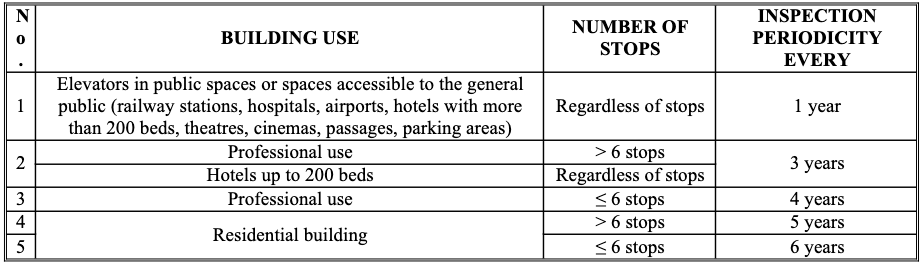
The inspections are initial inspections, after the installation of the elevators and before they are put into operation, or periodic inspections at regular intervals, depending on the type of building.
Inspection and certification apply to all elevators, whether new or old, installed in single-family homes, apartment buildings, commercial buildings, common-use areas and public buildings, industrial facilities, etc.
The maintenance and certification of an elevator are two different procedures with different purposes and requirements:
Elevator Maintenance
Purpose: Maintenance aims to preserve the smooth operation of the elevator and prevent breakdowns.
Procedure: It includes regular inspections, cleaning, lubrication, adjustments and replacement of worn parts.
Frequency: It is usually carried out at regular intervals.
Responsible parties: It is carried out by specialized technicians or elevator maintenance companies.
Elevator Certification
Purpose: Certification confirms that the elevator meets specific safety standards and regulations.
Procedure: It includes thorough inspections and tests for safety and regulatory compliance.
Frequency: Certification is usually required upon elevator installation and is repeated after a specific period of time or after significant modifications.
Responsible parties: It is carried out by authorized certification bodies or inspectors.
Consequently, maintenance focuses on operation and safety during the elevator’s everyday use, while certification ensures that the elevator meets all regulations and safety requirements.
The cost of the elevator inspection by the competent certification body is approximately €180.
The absence of an inspection and the absence of the relevant certificate entail penalties for the owner/manager.
These penalties are imposed by the following State Services during regular and extraordinary inspections or in the event of accidents:
General Secretariat for Industry of the Ministry of Development and Investments
Labor Inspectorate – S.EP.E.
Competent Regional Services
Competent Municipal Services
Potential fines range from €1,500 up to €60,000, depending on the type of violation and the impact it may have on the health and safety of users or employees (in the case of an elevator located in a building for professional use).
The first step is the inspection of the elevator by a recognized certification body.
After the inspection, and provided that observations requiring rectification arise, a report is issued.
According to the observations of the body, the elevator maintenance company must proceed with the corresponding rectification works.
Upon completion of the works, the body re-inspects in order to confirm that its observations have been rectified and requests the initial elevator license or a previous certificate.
If the elevator does not have a previous operating license or certificate, a technical file must be compiled, which includes mechanical drawings, an electrical diagram of the control panel, an elevator study and certificates for safety components. The technical file will be examined by the certification body that carried out the inspection, and the certificate will then be issued.
The compilation of a technical file is required when there is no operating license, or in the event that significant modifications have been made to the elevator.
For the completion of the legalization/licensing procedure of the elevator, the certificate must be submitted to the relevant municipality, whose technical service will issue the REGISTRATION of the elevator.
This registration has a duration equal to the duration of its certificate.
Upon expiration of the certificate, the registration also expires, and the owner/manager must submit the new certificate for the renewal of the registration.
Our company has a specialized certification department that can inform you, guide you and complete the formal procedures at every step, from the inspection to the registration of your elevator with the relevant municipality, at no charge.
If the inspection by the body identifies rectification works that must be carried out in order for the certificate to be issued, our company undertakes the works through our trained crews, whose know-how and years of experience have earned recognition and reliability in the field.